-
+86-13925102900
- quzkoon168@gmail.com
- Quan zhiguang (Guangzhou) Intelligent Technology Co., Ltd.


+86-13925102900
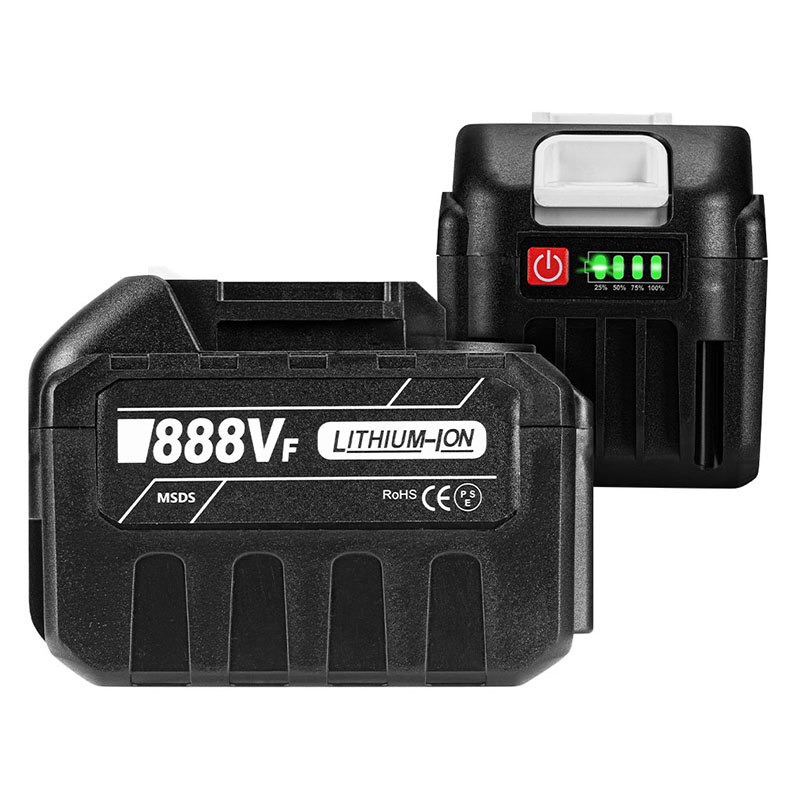
Power tools are an indispensable tool in any home, workshop or construction site. And now, in addition to the tool itself, we are faced with the question: which battery to choose? Especially when it comes to the popular lithium-ion batteries18V - 21V. This is a common voltage range that is used in a huge number of tools from different manufacturers. Let's try to figure out what to look for when choosing and how to use batteries wisely so that they serve you for a long time and reliably. There is a lot of useful information ahead, I hope it will help you make the right choice!
Before we get into the details, let's look at why this particular voltage range has become so popular. It is optimal in terms of power, weight and size. These batteries provide enough power to handle most tasks: drilling, screwing, cutting, sanding. At the same time, they are quite compact and lightweight, which increases the ease of use of the tool, especially when working at heights or in confined spaces. In addition,lithium ion batteries- this is already a standard, and they have a number of advantages over lead-acid ones: high energy density, lack of memory effect, long service life.
Not all batteries18V - 21Vare the same. They differ in several parameters that affect their characteristics and scope of application. Let's look at the main types:
The most common type of cells isLi-ion (lithium-ion) batteries. But inside Li-ion batteries, different cell chemistries can be used, which affects their characteristics: NMC (nickel-manganese-cobalt), NCA (nickel-cobalt-aluminum), LCO (lithium-cobalt oxide). NMC is now the most popular due to its good balance between cost, power and safety.
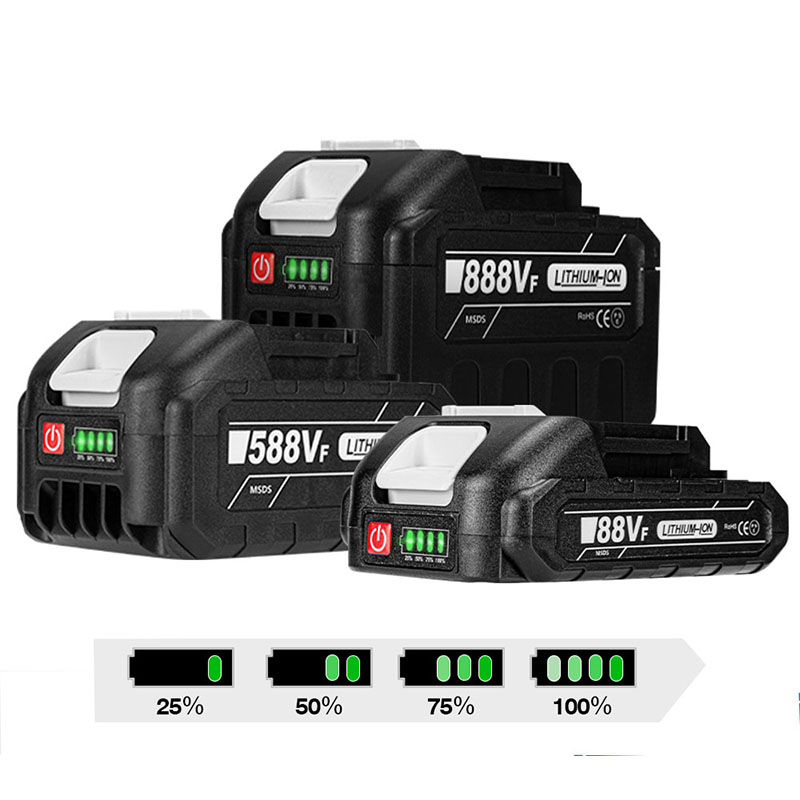
The capacity of the battery determines how long it can work without recharging. The larger the capacity, the longer you can work with the tool. For simple tasks such as drilling holes in soft materials, a 2.0-3.0 Ah battery may be sufficient. For more complex tasks, such as working with hard materials or using high-power tools, it is better to choose batteries 4.0-6.0 Ah or higher. It is important to consider not only the capacity, but also the weight of the battery - higher capacity usually means more weight.
The discharge current shows how much power the battery can deliver to the tool. The higher the discharge current, the more power the tool can produce. For tools that work with soft materials, a battery with a discharge current of 10A may be sufficient. Tools that work with hard materials, such as hammer drills or cordless saws, require a battery with a discharge current of 15A or higher.
This is a very important point! Not all batteries are compatible with the same brand of tools, even if they have the same voltage. Brands often use their own power management systems (Battery Management System, BMS), which do not allow the use of third-party batteries. Check battery compatibility with your tool before purchasing! Compatibility information is usually indicated in the instructions for the tool or on the manufacturer's website.
For example, **Makita** tools often use their own LXT battery system. Attempting to use a battery from another brand may damage the tool or battery. Likewise, **Bosch** tools use the Power X-Change battery system, and **DeWalt** tools use the XR system. Make sure the battery you choose is compatible with your system!
Proper care of batteries is the key to their long and trouble-free operation. Here are some simple rules:
Many users of Makita tools complain about the rapid loss of battery charge during storage. It turns out that for proper storage, you need to store batteries in a cool, dry place, with a charge level of approximately 50%. Regular charging to 50% every few months avoids deep discharge and preserves battery capacity.
When choosing a battery18V - 21V, please pay attention to the following factors:
Here are some of the most popular battery brands18V - 21V: